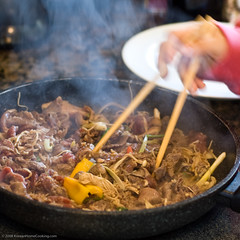
Showing posts with label authenticity. Show all posts

Thursday, April 5, 2012

Finding Good Sources of Information About Korean Food

The wide reach of the internet enables us to access many informational resources regarding Korean food, online and offline. Whether they be professional or personal sites, books, magazines, or blogs, there is much information in English and Korean to be perused by the Korean food lover. Amidst this avalanche, it can be difficult to discern whether a source is providing accurate information unless one knows a bit about Korean cuisine.

There are certain things that one can look out for when evaluating a source that will make it more likely that the information provided is correct. It does not require a deep understanding of the food, but a discernment for what makes a source more credible. The first question one must ask is, Who is the source? If it is a business, one should question their personal interests in regards to Korean cuisine. There should be a consistency in what they say about the food and the information they present on promotional materials. Professional sources, including professional blogs, can be great as they often take a serious approach to writing articles about Korean food. Personal bloggers can be great as well, but do not have an external check on their credibility like customers or a supervisor. They only answer to themselves and can write whatever they want as long as it does not violate their site host or blog publisher's guidelines. But I have comes across a number of personal bloggers that do care and do a much better job than some big, established media outlets, so the quality can vary.

Whether you are evaluating a personal or professional source, you need to assess how objective the writer is in presenting Korean food. Does he or she do the proper research and try to understand the information collected in an objective way? I don't think one needs to love Korean food or even like it to write about it objectively. Jeffrey Steingarten really did not like kimchi before he gave it a chance and tried out many samples at various Korean restaurants. It is important to keep in mind the writer's attitude toward the subject in order to determine whether he or she is being objective. Is the writer allowing his or her attitude to color the presentation of Korean food? Or is the writer presenting it objectively regardless of his or her own personal feelings? Also, does the writer allow for critical discussion about the ideas presented? For a business, it is understandable that they would not publish comments that go against their professional interests. Their interests may not be justifiable from a moral or logical standpoint, but a business is run for profit and needs to make money in order to survive. There are businesses that have a genuine interest in sharing information, but ultimately, it depends on the individual running the site and their own sense of ethics. A personal blogger may not be driven by profit, but may still have a personal interest in how the site is run. Of course, every blog host has the right to moderate comments according to how they see fit. But if the author deletes respectful, yet critical comments, it is obvious that he or she is not interested in frank discussion, but just promoting their own view or pride. Ultimately, it is up to the reader to assess what he or she is reading in a proper manner, to make sense of the information received in a way that is critical and meaningful. Even the best sources can get it wrong at some point despite their best effort. 

So the question is not only the credibility of the source, but the accuracy of the information. At the very least, the writer should be able to substantiate his or her argument by providing adequate proof. Just saying that Korean food looks like a mixture of certain cuisines does not provide evidence that it is so. There needs to be greater evidence in terms of an exploration into the history and background of Korean food. Korean cuisine certainly has influences from other cultures, but it has also provided its own influence to other cultures as well. This also does not take into account the vast indigenous sources of Korean cuisine. In order to substantiate any claim about Korean food, one must use sources that are historically and culturally valid from credible, verified sources such as documents, artifacts, cultural heritages, etc. Of course, it is impractical to expect every student of Korean cuisine to be an archaeologist or historian. Still, there are ways to verify certain things through proper research and documentation. In order to truly understand the nature of a cuisine, one must study the history and culture behind it.

Information about Korean food in English is very limited compared to resources in Korean. It makes sense that the culture of origin would have more resources regarding its cuisine than foreign cultures. It is in the personal interest of every culture to know its history, understand and preserve its culture, and carry out its valued traditions. Foreign sources only become available when another culture takes interest in its cuisine. As Korean food was not particularly known or popular in English speaking countries until recently, it would be a given that English resources would be limited in comparison to Korean ones. Sometimes, we need to dig for information instead of accepting what has been presented to us. We may be surprised to learn that there is a greater world than we have realized.

Posted by tastingkorea

Thursday, March 1, 2012

Writing Intelligently About Korean Cuisine

Korean food is a distinct cuisine with some influences from other cultures, but one cannot draw a conclusion about Korean food based on what they know about Chinese, Japanese, or other Asian cuisines. Unless one has studied the history and culture of Korean cuisine, one cannot speak with authority about the history and origins of Korean food. Generations of Koreans have eaten jjampong, a spicy seafood noodle dish, but to say that it is a traditional Korean dish would be false. The jjampong eaten in Korea has its origins in Chinese cuisine, with some Korean touches, so it is a Chinese Korean dish. The same can be said for yakiniku. Generations of Japanese have eaten this dish, but to say that it is an authentic Japanese dish would be false. It has its origins in Korean bbq, but with some Japanese flourishes, so it is a Korean Japanese dish. It is very presumptuous to assume that a dish has been influenced by another culture just because of its similarities to a dish from that cuisine. That is not good research or critical understanding.

It is our personal responsibility to make sure that we do our due diligence and spread awareness instead of ignorance and misinformation. This behooves you if you have a public forum to express your views, especially if you are a professional working in the media, particularly the food media. Food media professionals should be held to a much higher standard than personal bloggers, but no one is free from the responsibility to thoroughly research and disseminate the proper information. So I have been seriously disappointed by some food magazines and media outlets that have gotten it wrong in such an egregious way about Korean food, particularly such basic information as the name of Korean dishes, things that could easily be discerned through a proper internet search. I cannot believe that in the diverse melting pot of America, it would be that difficult for a food writer to find experts in Korean cuisine, be they Korean restaurant owners, cooking instructors, etc. If one is a professional writer, one should have the know-how to discern who the proper experts are and locate them. There are Korean government sites like the Korea Tourism Organization and Korea Taste, etc. that are actively promoting Korean food and would probably help you learn more about the cuisine as it is in their interest to do so. (I have listed them on my sidebar under "Korean Food - History and Culture".) But none of this information would be necessary if one truly researched and respected the topic at hand. 

Posted by tastingkorea

Korean Food and Msg

There is a misconception that Korean food uses a lot of msg. Some Korean restaurants do use msg, but it is not a necessary ingredient of Korean cuisine. Traditional Korean food does not use artificial msg. Natural msg can be found in anchovies, mushrooms, and seaweed, etc. The enticing flavor that is the cornerstone of Korean cuisine (Han Bok-Ryeoh, Korea's foremost expert on royal Korean cuisine) can be created through the use of the foods mentioned above as well as meat, seafood, beans, and/or vegetables. 


In Korean, monosodium glutamate (msg) is called: 

조미료 (jo-mi-ryo, also means 'seasoning' in general),

글루타민산느트륨 (gloo-tah-min-sahn-nah-teu-ryoom), 

글루타민산소다 (gloo-tah-min-sahn-soh-da) 

or less commonly, 글루타민산모노나트륨 (gloo-tah-min-sahn-moh-noh-nah-teu-ryoom)


Artificial msg is known as 화학 조미료 (hwah-hahk jo-mi-ryo, 'chemical msg') 

or 인공 조미료 (iin-gong jo-mi-ryo, 'synthetic msg'). 


Natural msg is known as 천연 조미료 (cheon-yeon jo-mi-ryo).


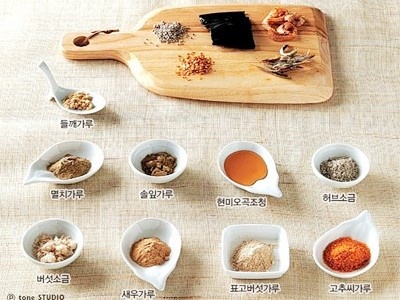
Natural Msg or 천연 조미료 via 행복지킴이


Nowadays, some Korean households and restaurants use msg as a convenience item, but due to the greater awareness of its ill effects on one's health, many use natural msg as it is healthful. Common ingredients in natural msg are mushrooms, anchovies, dashima (kelp), beef extract, etc. The ingredients are generally dried, roasted, and then powderized. I recommend not using msg when cooking Korean food because it cannot give the fresh and full flavor that can be obtained by using fresh and wholesome ingredients.

Posted by tastingkorea

Wednesday, January 4, 2012

Korean Food is a Cultural Heritage

As delicious as Korean food can be, it is more than something tasty to eat. It is a cultural heritage of Korea, both North and South. And so it should be given the proper respect due to something of that importance. That means acknowledging that it is a cultural heritage and honoring that by presenting Korean food with the right spirit, recognizing and understanding the place it comes from and respecting that in how one presents the food and how one comes to understand it. There are far too many people, whether bloggers or culinary professionals, who speak far too casually and flippantly about Korean food. Many of them are not ill-willed and show a nice appreciation for Korean food otherwise, but their lack of critical discernment as well as their ignorance and disregard for the history and culture behind Korean cuisine does a great disservice to a true understanding of the food. One does not have to be a Korean food expert to write about it intelligently, but one does need to do due diligence in terms of research, making sure that there is a solid basis for one's statements. Of course, perfection cannot be expected 100% of the time, but one should do one's best to research claims before making them.  

Korean food has been around for quite a long time. Many dishes have been prepared and honed for generations. So I am highly skeptical when I find someone who claims to have improved upon a time-honored recipe like kimchi chigae for example. Now, everyone has their own individual taste. Some prefer kimchi chigae with pork, some with tuna, and some with beef, etc. One needs to understand the intent behind each flavor profile to truly know if one has improved upon the dish. Kimchi chigae is not meant to be a heavy stew, so adding something like miso would counteract that purpose, not to mention dull the refreshing sharpness of the kimchi that is meant to be the star of the dish, hence the name, kimchi chigae. If one finds the broth too diluted for one's taste, that means that one should add more of the broth base such as pork, tuna, etc. to bring out a fuller and heartier flavor or use a more sour kimchi. What tastes good is a matter of interpretation. It is not up to the individual to dictate how a culture's cuisine should taste.


Additional Resources:

Korean Food in K-town vs. Korea by Tasting Korea

Rant: Yelp reviews of Korean food from One Fork, One Spoon

Posted by tastingkorea

Monday, January 2, 2012

Korean Food is Not Peasant Food, But Comfort Food

". . . there is a false perception that Corean cuisine is not “authentic” unless it is very cheap, rustic, very spicy, and served in a hole-in-the-wall somewhere in a Coreatown . . ."

Mickey Lee, "Martial Foodie’s Joy of Fine Dining Guide: WOO LAE OAK, 
the Finest Korean Restaurant in Washington, DC Area" (CultureMob)

I have heard Korean food referred to as a "peasant food" by some, but I would strongly disagree with this characterization. Sure, Korean food does have a lot of simple meals that are filling and made with accessible ingredients. But the term 'peasant food' implies that Korean food is mainly eaten or influenced by peasants and that the ingredients used are cheap and of lower quality. Korean cuisine is very resourceful in how it uses meats as well as the leftover curd from making tofu, etc., but being resourceful in using ingredients does not make something a peasant cuisine. Korean food uses most parts of chicken and beef--the flesh, bones, and innards as well as the blood of beef and pork.  The flesh and bones of pork is used as well. When cooking seafood, both the flesh and shell may be used. As for vegetables, grains, nuts, and fruits, they are generally peeled/hulled/shelled prior to cooking if there is a rough/hard skin or shell. Beans are cooked as a whole generally.


Kkori Gomttang or 꼬리곰탕 via 요안나의 행복이 팍팍


Jaengbahn Mahkguksu or 쟁반막국수 via Orihime Kitchen
Rough Buckwheat Noodles Served on a Platter

Of course, peasant dishes exist in the cuisine such as gomtang, which is beef soup made with bones, and makguksu, rough buckwheat noodles served in a sauce, which comes in many varieties (Chuncheon Makguksu Museum). But most Koreans are not farmers or farm laborers working the land and the ingredients used in Korean cooking may be accessible, but are not always cheap. The tenant farming system ended as a government policy in 1950 (Doopedia), which diminished the number of farmers in Korea. Rapid economic development also brought a decrease in the number of farmers with the opening of greater job opportunities. But even before then, the advent of modern farming techniques brought a gradual dwindling of the peasant lifestyle. There were discernible peasant communities during the late Joseon Dynasty (1392-1910), but this gradually became replaced by communities that engaged in modern farming practices. Traditional farmers still exist in Korea, but they are nowhere near as ubiquitous as farmers that rely on modern techniques. Even if one is a traditional farmer, unless one strongly adheres to the peasant lifestyle, retaining its traditional values and customs and practicing traditional ways of farming exclusively, it is very difficult to remain a peasant in today's society. Most traditional farmers today cannot be considered peasants as they engage in the social mores and technology around them outside of farming life. 

I really don't think one should judge the quality of an ingredient by its cost. Korean cooking focuses much more on high quality ingredients than the "lower grade" parts used in peasant food. There are peasant dishes made with "lower grade" cuts of meat such as oxtail and pig's feet as well as normally discarded animal parts such as innards and bones. But just because a cuisine uses components of a food that are normally discarded in other cultures does not make it a peasant cuisine. What each culture decides to consume is subjective and a matter of taste. Every food has its place. Just because a cut of meat is not tender and fatty does not make it of a lesser quality than meat that is. Tender and fatty cuts of meat may be prized in some meat-centric cuisines, but the Korean diet is not really a meat-centered one. There are many meat dishes in Korean cuisine, of course, but most Koreans do not make meat a large part of their diet for health, spiritual, and/or economic reasons. Some cuts of meat are good for roasting while others are good for making broths, etc. The texture and flavor of a cut is what determines its suitability for a certain style of cooking. So the question should be whether a cut of meat is suited for a particular cooking purpose and not whether it is tender or fatty. 


There is also a class connotation to the term 'peasant food' that I find offensive and don't really think applies to any ethnic cuisine as a whole. The term implies that the culture itself is one of peasantry and poverty, which is ridiculous when applied to industrialized countries where only a small portion of the population are farmers. 'Peasant food' is a term that is used too liberally by some to describe comfort food that is not high-end, but eaten mainly by the masses. Some people have a false notion that because a dish does not use complicated cooking techniques, it is not sophisticated. But sophistication lies in the refinement of the presentation and flavor of the final dish. Traditional Korean food is largely influenced by Korean royal court and Buddhist temple cuisine as well as the distinct characteristics of each region. It is based on the principle that food is medicine. Overprocessing food diminishes its nutritional content and is not always necessary to bring out the best flavor of a dish.  Korean food strives for a vibrance and purity in flavor that comes from using fresh ingredients seasoned to entice the palate, balancing the five tastes of sweet, sour, salty, spicy, and bitter for a savory flavor. I am aware that some people do not use the term "peasant food" with a dismissive connotation, but regardless, I still think it is a very limited way to characterize Korean cuisine. Most of the Korean restaurants overseas are family style/Korean bbq, so one can see the basis of this misunderstanding, but that does not excuse it.

Korean food is not peasant food, but comfort food. It is soothing to the soul. This quality emerges when Korean food is properly prepared with 정성 or 'jeongseong', a sincere and proper spirit. In Korean culture, food is a way to show hospitality, so great effort and consideration is given in preparing meals for guests. One should consider the health and well being as well as the palate of the eater when preparing his/her food. Korean food is meant to please the five senses of sight, sound, touch, taste, and smell. This is known as 오감만족 or  'ohgahm-mahnjoek', the satisfaction of the five senses. There is no formal term to denote 'comfort food' in Korean cuisine, but it is widely understood as a concept. The Korean culture can be a very sentimental one and many people do look fondly on the dishes that they grew up with made by their mother, grandmother, or neighborhood restaurants. When speaking about comfort food, the term is transliterated into Korean as  '컴포트 푸드' or can be translated as "그리운 옛맛 (Naver 영어사전)", 'the taste one yearns for from long ago'.

Posted by tastingkorea

Wednesday, November 23, 2011

Traditional Korean Cuisine


Han Style - Chapter on Hansik

In Korea, traditional Korean food is referred to as '한식' or hansik (pronounced 'hahn-shik'). According to Jang Eun-ju, a cuisine researcher at Han Style, "Hansik has developed in parallel with the changes of the Korean history and culture. Hansik is not only nutritious but also provides the joy of eating. And so, it is said that hansik is food that satisfies not only the mouth but the five senses, i.e. the senses of touch, sight, smell, taste and sound. The different color ingredients used to cook Korean foods satisfy the eyes. Korean foods taste delicious and smell good. Foods cooked using many different ingredients make interesting sounds when eating. The spoon and chopsticks allow for a delicate sense of touch. In other words, one can enjoy the beautiful colors and shapes of the dishes with their eyes and various tastes with their nose and mouth. Hansik allows diners to enjoy the pleasant sizzling sound when cooking bulgogi. It also provides diners with pleasant experiences that satisfy their sense of touch with lettuce wrapped rice."


an introduction to traditional Korean dishes, including royal court cuisine


Han Style - Cover


The Essence of Han Style


Cathlyn's Korean Food Challenge
Episode 7: Hansik Stories (Part 1)
An introduction to the heart of Korean cuisine

According to Han Style, the key principles of Korean cooking are/were*:

1. Main and side dishes were developed separately.

2. Spices and seasonings are used with fine detail, but in most cases, used similarly for each dish. (ie. There is a consistency to the way each dish is seasoned. - Tasting Korea)

3. Cut almost all ingredients beforehand as the cooking techniques are complicated.

4. The types of food are developed in a diverse manner according to their table setting.

5. There should be greater emphasis on the taste rather than the form of a dish.

* Translation of principles provided by Tasting Korea


Korean food can be divided into five categories (Han Style):

1. Royal Court Cuisine (궁중 음식)
2. Regional Foods (향토 음식)
3. Seasonal Foods (시절 음식)
4. Food for Special Occasions (의례 음식)
5. Buddhist Temple Cuisine (사찰 음식)

For a greater overview of traditional Korean cuisine, read "About Hansik" at Han Style and the Institute of Korean Royal Cuisine's articles on the "Overview of Korean Food" and "Seasonings and Style of Korean Food" as well as "Special Food for Special Occasions" and other articles in its series on "Traditional Korean Food Culture". A more extensive exploration of the history and culture of Korean traditional cuisine can be found in the "Food Culture" section of the Jeonbuk Food Culture Plaza site.


Seasonings Used in Korean Food


Chef Youngsun Lee explains the seasonal approach in cooking Korean food (Zen Kimchi):

"We are very seasonal. We have four seasons in Korea. So we do follow seasonal food, like, religiously. There are unwritten rules we have to follow as a Korean chefs:
  • Spring — bitter (new sprouts, etc): This will bring our appetites back from the long winter. Also eating new sprouts means getting nature’s force — life, new life in spring — from the new life into our body.
  • Summer — sour (vinegar base, citrus, etc): As the weather gets hot, we loose our [sense of] taste. So by having sour food, it brings our appetites [back] and also keeps our bod[ies] cool and moist.
  • Fall — spicy (hot pepper, etc): Prepare for a long, cold winter. Pepper was introduced to Korea about 300 years ago. Before that, there was not much spicy food. All of our kimchi used be white. [배김치 (bae kimchi) is pickled but not spicy.]
  • Winter — salty (kimchi, pickle, etc): Long-lasting food, such as fermented dishes are served to help in surviving winter. And we use “sweet” to balance all these flavors. But, again, sugar was introduced to Korea about 300 years ago, so before that we used to use honey or fruits for sweetener. Still till these days, we like to use honey or fruits for our sweetener instead of sugar."


(Han Style)

This video focuses on Korean food and its spread to other countries like France, Japan, and the United States as well as the health benefits of Korean cuisine with a focus on the art of making kimchi, fermented bean paste, and soft tofu as well as soft tofu stew. Buddhist temple cuisine and its purpose as well as Korean cuisine's spread to New York in restaurants like Bann are also featured.


("Tourism" section of Korea.net)

A quick and vibrant introduction to Korean cuisine. Introduces the core influences on Korean cuisine and the main types of dishes as well as more extensive coverage of the science and tradition of kimchi and jang (장, a term that refers to a group of sauces comprised of red pepper and soybean paste as well as soy sauce). Korean table settings, food for special occasions/different seasons, and the value of using one's hands in Korean cooking are also featured. A crash introduction to Korean food.

In the following video, watch how ancient Korean cuisine has influenced and shaped the Korean food we know today.


Posted by tastingkorea

Tuesday, November 15, 2011

What is Authentic Korean Cuisine?


The Institute of Royal Korean Cuisine at Changdeokgung Palace


Those of us who grew up in Korean homes have a good idea of homestyle Korean cooking and often other forms like restaurant fare and street food. But what constitutes authentic Korean cuisine? Discerning what is authentic from what is common may be challenging if we have not been exposed to the traditional forms of Korean food. That is not to say that food cannot be authentic if it is not traditional. According to Seoul Eats, the modern form of patbingsu emerged "after the Korean War and during the US occupation" using the "surplus supplies" from the U.S. army base (except for the red beans).

Being exposed to dishes in all their variations helps one determine the common approach to preparing a dish, but it is also important to study the history of Korean cuisine to understand what is truly authentic. Dishes emerge from a certain time and place and the spirit of the people and culture that inhabited that period of history. Modern Korean cuisine is greatly influenced by the culinary traditions of its past, but is a different creation in itself. The use of industrialized ingredients like commercial soy sauce, daenjang (된장, soy bean paste), and gochujang (고추장, red pepper paste) make it more convenient for modern day Koreans to prepare their own food. Of course, there are Koreans that make their own soy sauce and pastes, but preparing Korean food today is a much different endeavor from before the industrial age with the mass production of these essential ingredients. Food, like other products of culture, evolves with the times and the changing mentality of the people.


Dwaenjang or 된장 via Trifood


So what makes a food authentically Korean if the culture that creates it constantly changes? In order to determine that, one needs to look at the time and place from which a food originates as well as its ingredients and method of preparation. In order for a food to be authentic to a specific place, it needs to originate from there. There needs to be confirmation that the dish originated from that place without any foreign influence. This can be done through genuine historical records (written or oral) or artifacts. The combination of ingredients and the full preparation of those ingredients needs to be directly from that area. So kimchi is Korean although it uses a red chili pepper that may have originated elsewhere. The combination of ingredients (cabbage, red pepper flakes, garlic, etc.) and the method of preparation (kimchi fermentation technique) is original to Korea.


Fermented cabbage dishes do exist in other cultures like Germany where sauerkraut is made. Both kimchi and sauerkraut have cabbage as the main ingredient and use fermentation. However, the combination of ingredients used in kimchi is different from the combination used in sauerkraut. Kimchi uses pepper and garlic, etc. Sauerkraut just uses cabbage and salt. Kimchi and sauerkraut both use salt in the fermentation process, but in kimchi, it is necessary to coat individual leaves with a paste unless one chops them before brining. In sauerkraut, the cabbage is shredded, so it is just enough to mix them into the liquid brine to start fermentation.

The individual ingredients or the methods of preparation used in a dish do not have to be unique, but the combination and how that combination is prepared needs to originate directly from a particular place without any foreign influences. That is why one cannot argue that chicken soup is authentic to one specific place as many cultures raise chickens and use them in soup. It did not originate from one specific place. It originated from many places, so one can say that chicken soup is authentic to all of them. But samgyetang (삼계탕), a Korean soup made of stuffed chicken, rice, and ginseng, etc. is definitely unique to Korea in its combination of ingredients and style of preparation, so it is definitely an authentic Korean recipe. Uniqueness to a particular region makes a dish authentic to it. But authenticity is not about uniqueness, but the way a dish is conceived. Did it originate directly from a culture without foreign influence in terms of its combination of ingredients and the total preparation of those ingredients? Then, it is authentic.


Samgyetang or 삼계탕 Recipe from Top Chef Korea


Can fusion dishes be considered authentic? I suppose one could say that they are authentic to the influences that created them. For example, yakiniku. This is a Korean Japanese version of Korean bbq (Korean-style grilled meats). Is yakiniku Korean? It has a lot of Korean influences and is pretty close to Korean bbq in terms of its ingredients and preparation. However, one cannot deny that there is a slight Japanese influence in its sauce and cut of meat. It is not an authentic Korean or Japanese dish, but a largely Korean dish with Japanese flourishes. Just like mapa dubu is a largely Chinese dish with Korean flourishes. To be authentic to a region, a dish must be authentic in terms of its combination of ingredients and total preparation of those ingredients.

To get a better idea of what is truly authentic to Korean cuisine, you can read the series of articles on "Traditional Korean Food Culture" presented by the Institute of Korean Royal Cuisine. I have also written a post, Learning More About the History of Korean Food on the Web, as well as Great Blogs to Teach You About the Culture/Background of Korean Food to highlight some online resources to learn more about the background of Korean food. I have shared offline resources as well in my post Great Books to Learn More About Korean Food Culture.


Posted by tastingkorea

Thursday, November 10, 2011

Koreans Love to Mix It Up


One distinct quality of Korean food is the number of dishes that involve mixing and stirring. You can see this in dishes like bibimbap (비빔밥, 'mixed rice'), bibim mandu (비빔만두, 'mixed dumplings'), and bibim guksu (비빔국수, 'mixed noodles') as well as deopbap (덮밥, 'covered rice') dishes and desserts like patbingsu. Korea is a food culture that loves to mix and stir things up. In fact, bibimbap was once called 골동반 (pronounced 'gohldoengbahn'), represented as 骨同飯 in hanja (Sino-Korean characters), containing the meaning 'to mix in a jumble' according to professor Choi Joon-Shik. The point of mixing it up is to meld the flavors of each ingredient so that the resulting dish brings out the combined and individual flavors of each ingredient (Choi). There is something about this fusion that manifests the collective psyche of Koreans in such a magnificent way. Each ingredient is added for the unique contribution it brings to the flavor of the dish, but then, all ingredients are combined to bring out the collective flavor of the whole (Choi), a wonderful mishmash of different textures and flavors. This fusion of diverse ingredients creates a dynamism that cannot be achieved by individual ingredients alone. It is this complexity of textures and flavors that creates the richness and depth that stimulate and tantalize the tastebuds. It is through this potpourri that one can see the rich and dynamic spirit of Korean people and culture, the sense of oneness or uri (우리, 'us') mentality that is characteristic of the people and the passion that can be seen in many Koreans, our movies, and our dramas. Koreans really love a deep and hearty flavor known as 고소한 맛 (pronounced 'gosohahn maht') and bibim dishes do an excellent job of bringing that out.

Here are some wonderful examples of the mixing that Korean dishes are known for:


Bibim Naengmyeon or 비빔냉면 via 무지개의 달콤한 세상


Bibim Guksu or 비빔국수 via Beyond Kimchee


via One Fork, One Spoon


Bibimbap or 비빔밥 via Eating and Living


(Nalchi Ahl - 'flying fish roe' ; Hwe - 'raw fish')


Posted by tastingkorea

Tuesday, November 8, 2011

Korean Food in K-town vs. Korea

Is Korean food in K-town (Koreatown) fully representative of the food one can find in Korea?

The answer is no. No matter how many restaurants you have eaten in K-town, you cannot understand the depth and breadth of Korean cuisine until you actually go and eat in Korea. Having a much larger population (almost 49,000,000) than the select group of Koreans who live in the U.S. (around 2,000,000), Korea has a greater diversity of restaurants and dishes served to the general population. Where in K-town can you find a restaurant specializing and serving only one dish? I recall eating at a small restaurant near Daegu (Korea's third largest city) that served only samgyetang (soup made of chicken stuffed with rice) and accompanying banchan (side dishes) like chicken gizzards, kkaktugi (cubed radish kimchi), etc. It was delicious. Where can you find Korean restaurants specializing in organic food in the U.S.? I remember a restaurant near the mountains of Daegu that served organic vegetables grown on its farm. Those are just two examples of Korean restaurants in one area of Korea that you are not likely to find in the U.S., a country with the largest Korean population overseas outside of China. Korean restaurants overseas cannot afford to have such a specialized focus due to the smaller population of Koreans in those countries.

Of course, eating Korean food as prepared in K-town does give you a good idea of a certain style of food found in Korean family restaurants. Eating Korean bbq or a homestyle meal can give you a good idea of what to expect from such establishments serving those dishes. The bulk of overseas restaurants are family style, catering to the local Korean immigrant/expatriate community. Most Koreans living in the U.S. left Korea before or during the 70's and 80's, so restaurants cater to this demographic who form the majority of their client base. Family restaurants do the best in the Korean community because they appeal to the widest demographic, from young to old, lower to upper class. Since Korean cuisine has not received wide notice outside of the Korean community until recently, restaurants had to make sure they served their Korean base. It was and is a matter of market demand just like with any other business. But one fortunate effect of this is that Korean food is one of the least bastardized cuisines in America. Even so, there is no need to adapt it for the tastes of the mainstream as it has gotten more popular without this modification. As long as Korean food is available and enjoyable for those who seek it, that is all that matters. Quality over quantity.

Now, there could be a greater variety of Korean restaurants in K-town compared to what is available today. But with higher-end restaurants like Dohwa (traditional), Danji (authentic Korean and fusion) and Jungsik (New Korean - Korean with French techniques) and the opening of Kristalbelli (Korean bbq cooked on crystal infrared grills) by J.Y. Park, the Korean music mogul, the Korean food scene is expanding in New York and the rest of America. There are also places like Bibigo where you can create your own bowl of bibimbap on order, serving "fast Korean", Korean food made quickly, but without the downsides commonly associated with fast food. As Korean food becomes better known, perhaps there will be more opportunities for entrepreneurs to open restaurants that go beyond the known standard of Korean bbq or homestyle cooking.


Kristalbelli


Posted by tastingkorea

Monday, October 24, 2011

The Origin of Buta Kimchi is Jeyuk Bokkum

Buta Kimchi is a Korean-Japanese dish that originates from Jeyuk Bokkeum or 제육볶음 in Korean. Jeyuk means 'pork'. Some bloggers have used 'stirfry' as a translation for 'bokkeum', but I don't like using 'stirfry' as it refers to the traditional Chinese cooking technique of "cutting [food] into small pieces and stirring constantly in a lightly oiled wok or frying pan over high heat (Webster's Dictionary)." Jeyuk Bokkeum does not require constant stirring, but constant attention, so I prefer to use 'saute' as a translation for bokkeum. Jeyuk Bokkeum is also known as Dwaeji Bulgogi (돼지 불고기, 'fire pork' or barbecued pork). "Thinly sliced pork is marinated in a spicy chili pepper paste (gochujang) based sauce typically with lots of fresh garlic and ginger (Eating and Living)."


The red pepper paste not only adds spice, but masks the gamy smell (비린내) of pork. Korean food is really good about masking the 비린내 of meats. You will notice this in Jeyuk Bokkeum as well as other meats like crab and beef, etc.


Posted by tastingkorea

The Origin of Yakiniku is Korean BBQ

Yakiniku/Korean BBQ via Chef Taro


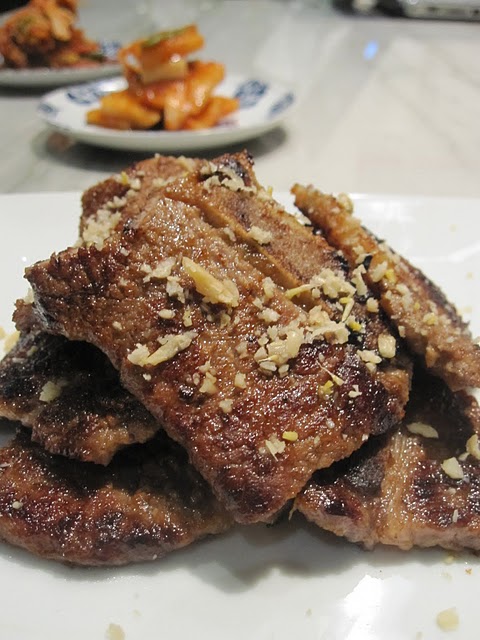
Yakiniku is a popular dish in Japan, but its origins are in Korean BBQ. Korean immigrants started the original form of yakiniku, known as horumon-yaki, by grilling tripe and large intestine. Later on, they added meats used in Korean bbq and called it 'yakiniku'. The Japanese have added their own flourish to this dish, but "it remains close to its Korean roots (Chef Taro)."

Here are the most common meats grilled in Korean bbq:


According to Simon Park of "The Heart of Food", "Samgyeopsal is nothing more than uncured pork belly, sliced thin like bacon but with the rind removed. The name, which translates to “three layered meat”, is a description of the strata of meat and fat that invariably makes up this cut. Typically, it is prepared in the Korean BBQ style i.e. cooked and eaten at the table one piece at a time. Traditionally, the cooked meat is dipped into a salt & pepper dipping sauce prior to consumption."


Wikipedia has an excellent overview of Korean bbq and the types of meat grilled.


Posted by tastingkorea

The Origin of Meat Jun


Meat jun, a popular dish in Hawaii, originates from the Korean dish '고기전' (meat fritter), pronounced 'gogijuhn'. '고기' stands for meat and '전' stands for 'fritter'. 고기전 is usually made by seasoning meat and then dipping it into batter to be fried. There are many variations of this dish as can be seen here, but here are a few of the well known versions, usually made of beef:


Pork 고기전 or 돼지 고기전 via 빵굽는타자기


According to Grace Keh of San Francisco Food, "This is one of those Korean dishes that is commonly presented at parties and feasts, but for some reason, this dish is rarely served up on casual dinner tables. In fact, this applies to many different “jun” dishes including the ever popular fish-jun (생선전). The reason is perhaps due to this being the type of dish that requires quite a bit of preparation and time, and historically, food like “jun” were prepared for the emperor of the country. Meat or fish needed for this dish was not readily available for the common folk. Even in modern day Korea, when a special occasion comes up, the ladies will gather to make all kinds of jun. . . . it’s not readily made or served in Korean restaurants. You would also have to ask for “Gogi-Jun”, should they have it. It will be more commonly found at buffet restaurants, or at any Korean festivity." Outside of these occasions, you will see jun most frequently prepared for jesa (제사), a Korean ceremony to honor one's ancestors.


Here is her English recipe for 고기전:


Posted by tastingkorea
Related Posts Plugin for WordPress, Blogger...