Showing posts with label influence of Korean cuisine. Show all posts

Thursday, March 1, 2012

Writing Intelligently About Korean Cuisine

Korean food is a distinct cuisine with some influences from other cultures, but one cannot draw a conclusion about Korean food based on what they know about Chinese, Japanese, or other Asian cuisines. Unless one has studied the history and culture of Korean cuisine, one cannot speak with authority about the history and origins of Korean food. Generations of Koreans have eaten jjampong, a spicy seafood noodle dish, but to say that it is a traditional Korean dish would be false. The jjampong eaten in Korea has its origins in Chinese cuisine, with some Korean touches, so it is a Chinese Korean dish. The same can be said for yakiniku. Generations of Japanese have eaten this dish, but to say that it is an authentic Japanese dish would be false. It has its origins in Korean bbq, but with some Japanese flourishes, so it is a Korean Japanese dish. It is very presumptuous to assume that a dish has been influenced by another culture just because of its similarities to a dish from that cuisine. That is not good research or critical understanding.

It is our personal responsibility to make sure that we do our due diligence and spread awareness instead of ignorance and misinformation. This behooves you if you have a public forum to express your views, especially if you are a professional working in the media, particularly the food media. Food media professionals should be held to a much higher standard than personal bloggers, but no one is free from the responsibility to thoroughly research and disseminate the proper information. So I have been seriously disappointed by some food magazines and media outlets that have gotten it wrong in such an egregious way about Korean food, particularly such basic information as the name of Korean dishes, things that could easily be discerned through a proper internet search. I cannot believe that in the diverse melting pot of America, it would be that difficult for a food writer to find experts in Korean cuisine, be they Korean restaurant owners, cooking instructors, etc. If one is a professional writer, one should have the know-how to discern who the proper experts are and locate them. There are Korean government sites like the Korea Tourism Organization and Korea Taste, etc. that are actively promoting Korean food and would probably help you learn more about the cuisine as it is in their interest to do so. (I have listed them on my sidebar under "Korean Food - History and Culture".) But none of this information would be necessary if one truly researched and respected the topic at hand. 

Posted by tastingkorea

Wednesday, November 23, 2011

Traditional Korean Cuisine


Han Style - Chapter on Hansik

In Korea, traditional Korean food is referred to as '한식' or hansik (pronounced 'hahn-shik'). According to Jang Eun-ju, a cuisine researcher at Han Style, "Hansik has developed in parallel with the changes of the Korean history and culture. Hansik is not only nutritious but also provides the joy of eating. And so, it is said that hansik is food that satisfies not only the mouth but the five senses, i.e. the senses of touch, sight, smell, taste and sound. The different color ingredients used to cook Korean foods satisfy the eyes. Korean foods taste delicious and smell good. Foods cooked using many different ingredients make interesting sounds when eating. The spoon and chopsticks allow for a delicate sense of touch. In other words, one can enjoy the beautiful colors and shapes of the dishes with their eyes and various tastes with their nose and mouth. Hansik allows diners to enjoy the pleasant sizzling sound when cooking bulgogi. It also provides diners with pleasant experiences that satisfy their sense of touch with lettuce wrapped rice."


an introduction to traditional Korean dishes, including royal court cuisine


Han Style - Cover


The Essence of Han Style


Cathlyn's Korean Food Challenge
Episode 7: Hansik Stories (Part 1)
An introduction to the heart of Korean cuisine

According to Han Style, the key principles of Korean cooking are/were*:

1. Main and side dishes were developed separately.

2. Spices and seasonings are used with fine detail, but in most cases, used similarly for each dish. (ie. There is a consistency to the way each dish is seasoned. - Tasting Korea)

3. Cut almost all ingredients beforehand as the cooking techniques are complicated.

4. The types of food are developed in a diverse manner according to their table setting.

5. There should be greater emphasis on the taste rather than the form of a dish.

* Translation of principles provided by Tasting Korea


Korean food can be divided into five categories (Han Style):

1. Royal Court Cuisine (궁중 음식)
2. Regional Foods (향토 음식)
3. Seasonal Foods (시절 음식)
4. Food for Special Occasions (의례 음식)
5. Buddhist Temple Cuisine (사찰 음식)

For a greater overview of traditional Korean cuisine, read "About Hansik" at Han Style and the Institute of Korean Royal Cuisine's articles on the "Overview of Korean Food" and "Seasonings and Style of Korean Food" as well as "Special Food for Special Occasions" and other articles in its series on "Traditional Korean Food Culture". A more extensive exploration of the history and culture of Korean traditional cuisine can be found in the "Food Culture" section of the Jeonbuk Food Culture Plaza site.


Seasonings Used in Korean Food


Chef Youngsun Lee explains the seasonal approach in cooking Korean food (Zen Kimchi):

"We are very seasonal. We have four seasons in Korea. So we do follow seasonal food, like, religiously. There are unwritten rules we have to follow as a Korean chefs:
  • Spring — bitter (new sprouts, etc): This will bring our appetites back from the long winter. Also eating new sprouts means getting nature’s force — life, new life in spring — from the new life into our body.
  • Summer — sour (vinegar base, citrus, etc): As the weather gets hot, we loose our [sense of] taste. So by having sour food, it brings our appetites [back] and also keeps our bod[ies] cool and moist.
  • Fall — spicy (hot pepper, etc): Prepare for a long, cold winter. Pepper was introduced to Korea about 300 years ago. Before that, there was not much spicy food. All of our kimchi used be white. [배김치 (bae kimchi) is pickled but not spicy.]
  • Winter — salty (kimchi, pickle, etc): Long-lasting food, such as fermented dishes are served to help in surviving winter. And we use “sweet” to balance all these flavors. But, again, sugar was introduced to Korea about 300 years ago, so before that we used to use honey or fruits for sweetener. Still till these days, we like to use honey or fruits for our sweetener instead of sugar."


(Han Style)

This video focuses on Korean food and its spread to other countries like France, Japan, and the United States as well as the health benefits of Korean cuisine with a focus on the art of making kimchi, fermented bean paste, and soft tofu as well as soft tofu stew. Buddhist temple cuisine and its purpose as well as Korean cuisine's spread to New York in restaurants like Bann are also featured.


("Tourism" section of Korea.net)

A quick and vibrant introduction to Korean cuisine. Introduces the core influences on Korean cuisine and the main types of dishes as well as more extensive coverage of the science and tradition of kimchi and jang (장, a term that refers to a group of sauces comprised of red pepper and soybean paste as well as soy sauce). Korean table settings, food for special occasions/different seasons, and the value of using one's hands in Korean cooking are also featured. A crash introduction to Korean food.

In the following video, watch how ancient Korean cuisine has influenced and shaped the Korean food we know today.


Posted by tastingkorea

Monday, October 24, 2011

The Origin of Buta Kimchi is Jeyuk Bokkum

Buta Kimchi is a Korean-Japanese dish that originates from Jeyuk Bokkeum or 제육볶음 in Korean. Jeyuk means 'pork'. Some bloggers have used 'stirfry' as a translation for 'bokkeum', but I don't like using 'stirfry' as it refers to the traditional Chinese cooking technique of "cutting [food] into small pieces and stirring constantly in a lightly oiled wok or frying pan over high heat (Webster's Dictionary)." Jeyuk Bokkeum does not require constant stirring, but constant attention, so I prefer to use 'saute' as a translation for bokkeum. Jeyuk Bokkeum is also known as Dwaeji Bulgogi (돼지 불고기, 'fire pork' or barbecued pork). "Thinly sliced pork is marinated in a spicy chili pepper paste (gochujang) based sauce typically with lots of fresh garlic and ginger (Eating and Living)."


The red pepper paste not only adds spice, but masks the gamy smell (비린내) of pork. Korean food is really good about masking the 비린내 of meats. You will notice this in Jeyuk Bokkeum as well as other meats like crab and beef, etc.


Posted by tastingkorea

The Origin of Yakiniku is Korean BBQ

Yakiniku/Korean BBQ via Chef Taro


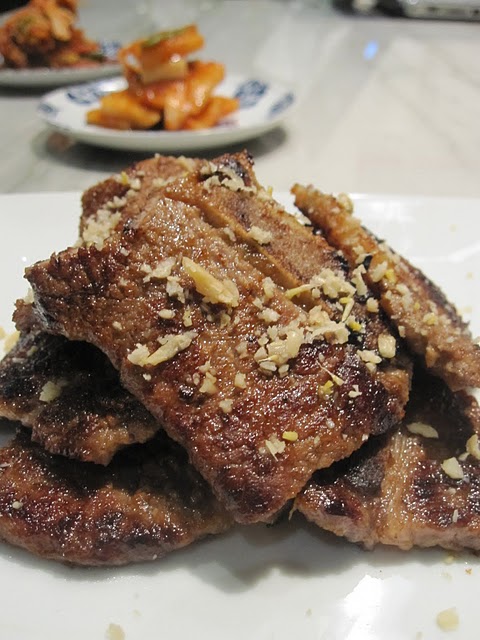
Yakiniku is a popular dish in Japan, but its origins are in Korean BBQ. Korean immigrants started the original form of yakiniku, known as horumon-yaki, by grilling tripe and large intestine. Later on, they added meats used in Korean bbq and called it 'yakiniku'. The Japanese have added their own flourish to this dish, but "it remains close to its Korean roots (Chef Taro)."

Here are the most common meats grilled in Korean bbq:


According to Simon Park of "The Heart of Food", "Samgyeopsal is nothing more than uncured pork belly, sliced thin like bacon but with the rind removed. The name, which translates to “three layered meat”, is a description of the strata of meat and fat that invariably makes up this cut. Typically, it is prepared in the Korean BBQ style i.e. cooked and eaten at the table one piece at a time. Traditionally, the cooked meat is dipped into a salt & pepper dipping sauce prior to consumption."


Wikipedia has an excellent overview of Korean bbq and the types of meat grilled.


Posted by tastingkorea

The Origin of Meat Jun


Meat jun, a popular dish in Hawaii, originates from the Korean dish '고기전' (meat fritter), pronounced 'gogijuhn'. '고기' stands for meat and '전' stands for 'fritter'. 고기전 is usually made by seasoning meat and then dipping it into batter to be fried. There are many variations of this dish as can be seen here, but here are a few of the well known versions, usually made of beef:


Pork 고기전 or 돼지 고기전 via 빵굽는타자기


According to Grace Keh of San Francisco Food, "This is one of those Korean dishes that is commonly presented at parties and feasts, but for some reason, this dish is rarely served up on casual dinner tables. In fact, this applies to many different “jun” dishes including the ever popular fish-jun (생선전). The reason is perhaps due to this being the type of dish that requires quite a bit of preparation and time, and historically, food like “jun” were prepared for the emperor of the country. Meat or fish needed for this dish was not readily available for the common folk. Even in modern day Korea, when a special occasion comes up, the ladies will gather to make all kinds of jun. . . . it’s not readily made or served in Korean restaurants. You would also have to ask for “Gogi-Jun”, should they have it. It will be more commonly found at buffet restaurants, or at any Korean festivity." Outside of these occasions, you will see jun most frequently prepared for jesa (제사), a Korean ceremony to honor one's ancestors.


Here is her English recipe for 고기전:


Posted by tastingkorea

Thursday, October 13, 2011

Introduction to Korean Food in the Media


- an in-depth introduction to the main types of ingredients used in Korean cooking


- a nice introduction to the Korean food scene in New York City's Koreatown and its flavors as well as some classic Korean dishes


A good overview of Korean drinks. 20 Delicious Korean Drinks from CNNgo


Posted by tastingkorea

Related Posts Plugin for WordPress, Blogger...